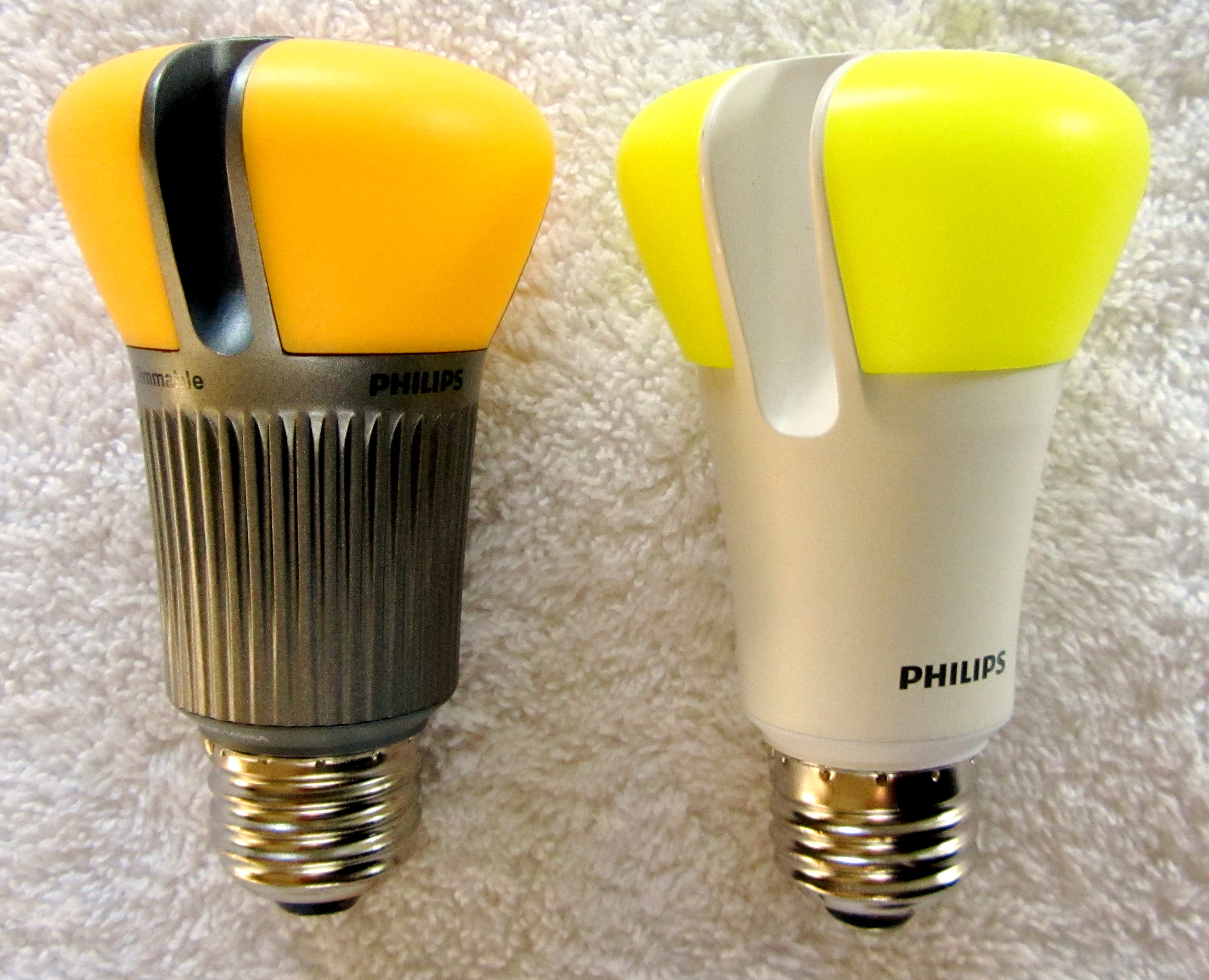
LED bulbs in several formats. Source: Wikimedia Commons (CC BY-SA)
Reading an LED bulb label
In Canada, retail bulbs display several standardized details on the package. These figures allow objective comparison and help confirm suitability for the intended fixture.
Wattage and luminous flux (lumens)
Wattage indicates how much electricity is consumed, not how bright the bulb appears. Luminous flux in lumens is the actual light output. An 8–10 W LED can match a former 60 W incandescent in brightness.
| Luminous flux (lumens) | Incandescent equivalent | Typical LED (watts) |
|---|---|---|
| 450 lm | 40 W | 4–6 W |
| 800 lm | 60 W | 8–10 W |
| 1100 lm | 75 W | 11–13 W |
| 1600 lm | 100 W | 14–18 W |
Certifications and standards in Canada
LED bulbs sold in Canada are subject to regulatory requirements administered by Natural Resources Canada under the Energy Efficiency Act. Imported products offered for sale must meet minimum efficiency thresholds.
ENERGY STAR certification
ENERGY STAR Canada identifies products that exceed minimum regulatory levels. A certified bulb must, among other criteria:
- Declare a rated life of at least 15,000 hours for A-shape bulbs
- Maintain at least 70% of initial luminous flux after the tested period (L70 criterion)
- Have a minimum CRI of 80
- Start immediately without a warm-up period
Certified product lists are available on the ENERGY STAR website.
cUL or cCSA approval
In Canada, electrical equipment must bear approval from an organization accredited by the Standards Council of Canada. A “cUL” (Underwriters Laboratories) or “cCSA” (CSA Group) mark indicates evaluation against Canadian standards. This differs from a U.S.-only UL mark.
Caution
Bulbs without cUL or cCSA marking, sometimes sold at low cost through online marketplaces, do not assure compliance with Canadian safety standards. Check the package or the bulb itself for these marks.
Lifespan and warranty
Manufacturers express LED life in hours of use under defined conditions. The L70 rating — when output falls to 70% of the initial level — is the industry standard measure.
Consumer bulbs typically claim 10,000 to 25,000 hours. In practice, ambient heat, switching frequency, and dimmer quality can shorten actual life.
Many brands include a replacement warranty, often two to five years, covering manufacturing defects but not normal wear.
Formats available in Canada
Canadian retailers — including RONA, Home Depot Canada, and Canadian Tire — stock a broad range of shapes:
- A19 / A21: standard shape for most indoor fixtures. A19 is the most common.
- PAR20, PAR30, PAR38: directional spots for recessed and track lighting.
- BR30, BR40: flood bulbs for wide-angle ceiling fixtures.
- G25: globe bulbs for bathroom vanity fixtures.
- Candelabra (E12): chandeliers and decorative sconces.
- T8 LED tubes: replacement for fluorescent tubes in utility spaces.
Extreme temperatures and Canadian conditions
LED bulbs generally operate from about -20 °C to +40 °C, which suits Canadian winters, including unheated detached garages and sheds.
Unlike compact fluorescents, LEDs do not need a warm-up period in cold weather to reach full brightness. That trait is useful for outdoor security lighting and motion-sensor fixtures.
LEDs are sensitive to excessive heat. In fully enclosed fixtures not designed for LEDs, trapped heat can shorten bulb life. Confirm the packaging states “suitable for enclosed fixtures” or “enclosed fixture rated.”
Connected bulbs and home automation
“Smart” LED bulbs (Wi-Fi, Zigbee, Z-Wave, Bluetooth) can be controlled from a phone app or home automation hub. Brands sold in Canada include Philips Hue, LIFX, Sengled, and TP-Link Tapo.
These bulbs usually need a home network connection and, for some protocols, a dedicated hub. Voice-assistant compatibility varies by product generation and where the bulb was purchased.
Connected bulbs draw standby power — typically about 0.5 to 2 W — while remaining on the network even when the light is off.